Book Review : Weaving Magic by Dr. Pravat Kumar Padhy
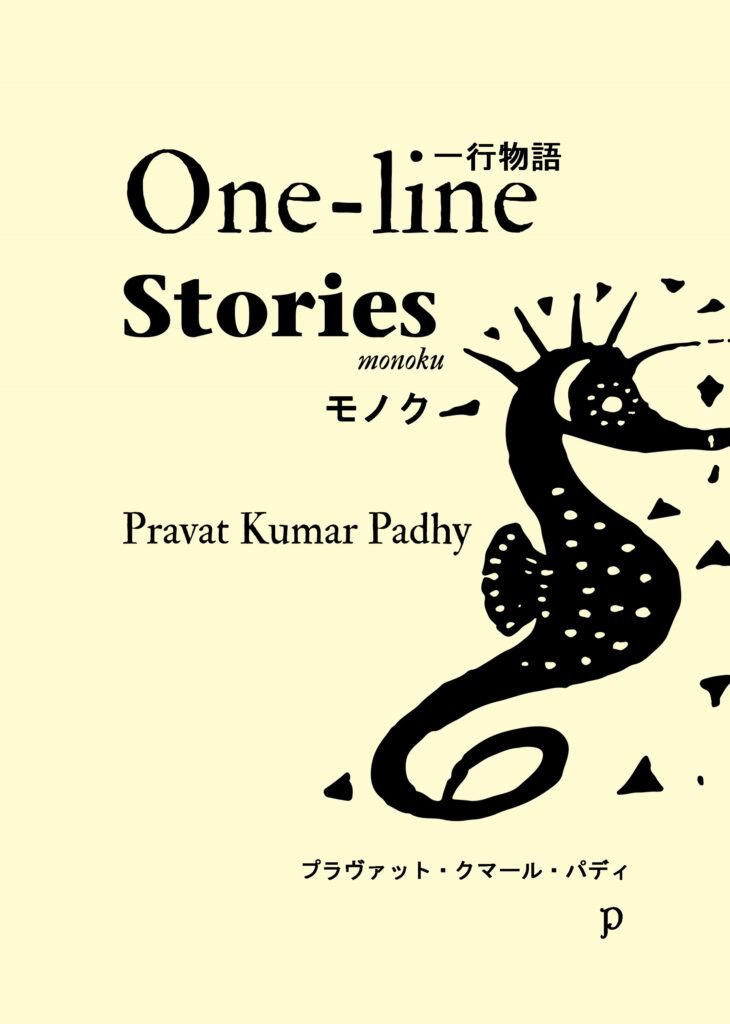
One-line Stories by Dr. Pravat Kumar Padhy
Penprints, 2026
ISBN-10 : 8199956003
ISBN-13 : 978-8199956001
Reviewed by Geethanjali Rajan
Johannes S. H. Bjerg says about one-line haiku:
“One-line haiku seems to be a discipline of its own. What I have discovered is that it represents another way of thinking, perceiving (sensing), of “speaking” than a three-line haiku and often with more energy in it as it’s even more condensed in thought and sensing than a three-line verse.”
Monoku or one-line haiku in English can be a challenge even to experienced writers, with the jux and the enjambment, the curve-back and the super brevity that make it as exciting as precise, in landing the desired effect. It is with this in mind that I read Dr. Padhy’s latest offering, a collection of monoku, which I found to be high in energy, spontaneous and the starting point of many stories.
a stone in her tiny hand once a mountain
The poem takes us on a long journey back in time to the origins of a stone. The poet contrasts the stone in a tiny hand in the present moment with the giant mountain of the past, and leads the reader deftly to a future of giant possibilities.
Alan Summers, in the Foreword to One-line Stories tells us of his search for single-line ku could be an effective start or finish of a short story or novel. Dr. Padhy’s one-liner poems can definitely do that. For instance, this one:
the train I board flags the green light of memories
Wouldn’t this make a good beginning of a novel? Or maybe, this works even better if the protagonist has finished his story and is boarding a train. Doesn’t it all depend on the imagination of the reader?
Dr. Padhy has never been one to let the reader shirk his/her responsibility. His haiku and tanka require that the reader engage with the poem and do the work of completing the image, moment or story in their own minds. In the case of the monoku in this book too, he makes the reader an important part of the poem, without really handing everything in a platter. (This is perhaps, a trait that he acquired from his researcher-scientist-teacher profession and has most effectively used in his haiku writing as well.)
who I am the body contours who I am not
In Japanese haiku, the poets have a choice of which of the scripts they use to depict their haiku. Will they use hiragana, katakana or kanji? And a haiku can have a mixture of all three scripts. The choice depends on what impression or feeling a poet wants to convey through the haiku. Does one want a more formal tone or is it a softer emotion? Are there homophones that need to be distinguished? Is there a light humour intended? All of this (and more) decides the choice. Similarly, does one want to write it in one line or three? That too is less of a genre difference and more of personal choice, unlike in English Language Haiku where the rules of engagement change with the number of lines.
dreams she conceals winter chrysanthemum
This haiku is an example of a one-breath (or even a rushed breath) poem. It is in the re-reading or the engagement with the words after we have slowed down, that the meanings and layers emerge, the possibilities within our own fertile imaginations lending to it growth, separate from what the poet intended. I for one, was struck by the image of the multiple and complex layers in the chrysanthemum. For some strange reason, pairing it with winter gave me an image of white blooms (winter=white). Another reading, and the various colours emerged but only after I nudged my brain to the colourful blooms at the neighbourhood florist! And then the layers unfold as the reader decides where to pause in the ku – after ‘dreams’ or ‘conceals’. Each possibility reveals a different layer and adds to the permutations for the reader. To visualise the colour, the season, the transitions, all leave the reader richer. And I would have missed all of this by giving it just a cursory read.
so close to the moon every kiss a nearby star
Dr. Padhy writes with ease and with the intent of an engaging storyteller. This haiku made me stop at each moment and think of the potentiality, for that’s what stories must do. Make us think of a different ending, an ability to change hopelessness into golden sunrises and unpolluted rivers. The poet provides us that spark and we must create the magic together with him.
The poet states in his preface to the One-line Stories: “Poems come to my mind as fragrance to flower. Anything I see, it creates a symbolic frame ……… when I see a small grain of seed, I feel “it is tiny / because it nests with care / the mightiest in it.”
a piece of chalk in my pocket first day of retirement
Perhaps, the first day of retirement made for a joyous commitment to a deeper and longer journey on the haikai path for Dr Padhy.
For those of us who love one-line haiku, this book is a delight. Please read this for Dr. Padhy’s poems and for Alan Summers’ insightful foreword on one-line haiku.
(One-line Stories by Dr. Pravat Kumar Padhy is available on Amazon.)
Note: For more in-depth information on monoku, the poet’s article “Monoku: Historical Perspective and Experimenting with Structural Style,” published in The Wales Haiku Journal Blog, September 2022 is an informative article that can be read here: https://www.waleshaikujournal.com/post/monoku.
Link for the book at Penprints- One-line stories by Dr. Pravat Kumar Padhy
About
Pravat Kumar Padhy obtained his Master of Science and a Ph.D from Indian Institute of Technology, ISM Dhanbad. He is a mainstream poet and a writer of Japanese short-form poetry. His poem “How Beautiful” is included in the undergraduate university-level curriculum. His haiku won The Kloštar Ivanić International Haiku Award, Vancouver Cherry Blossom Festival Invitational Award, IAFOR Vladimir Devidé Haiku Award, Setouchi Matsuyama Photo Haiku Award, Katherine Mansfield International Haiku Award and others. Pravat’s haiku are featured at Mann Library, Cornell University, and his tanka appeared in “Kudo Resource Guide”, University of California, Berkeley. A collage of video featuring his haiku is included in the school curriculum, The New Trier High School, Northfield, Illinois, USA.
He introduced new forms of poetry: Hainka: a fusion of haiku and tanka, Braided Haiku and Micro-Haiga (One-word Haiku). He is credited with the publication of eight collections. He served as a panel judge of “The Haiku Foundation’s Touchstone Awards for Individual Poems” and a member of the jury of the “Wind on the Cherry Blossoms Haiku Project,” Italy (2026). He was on the editorial board of the journal ‘Under the Bashō’ as haibun and haiga editor.
Geethanjali Rajan teaches English and Japanese in Chennai, India. She is the author of longing for sun longing for rain (haikai verse, Red River, 2023, longisted for The Wise Owl Literary Awards 2025) and co-author of Unexpected Gift (a book of collaborative verse with Sonam Chhoki (Bhutan), Éditions des petits nuages,Canada, 2021, Touchstone Distinguished Books Award Shortlist for 2021 by The Haiku Foundation.). Her essays on haikai and reviews of poetry have appeared in Kavya Bharati, The Wise Owl, Usawa Literary Review, World Haiku Review and Café Haiku. She has been editing haiku at cattails since 2017.
← Previous | Back to Issue | Next →

Leave a Reply