Category: Reflections/Essays

Exploring the Meta-Haiku

By Chen-ou Liu, Canada


Bridging traditional brevity with sharp self-awareness, the meta-haiku turns the poetic lens inward. Rather than capturing a fleeting moment in nature, this self-reflexive form makes the anxious act of composition—and the constraints of its own three-line structure—the subject of the poem.

For example:

before false dawn
just three lines, blinking cursor
after sun down

There is a clear syntactic parallelism between Lines 1 and 3 (before [noun phrase] / after [noun phrase]). This grammatical mirroring creates a structural frame, establishing a mechanical, almost clockwork rhythm that evokes the passage of time. Within this frame, the middle line—and the narrator—seems trapped in a temporal loop.

By balancing the beginning and the end, the haiku formally enacts the very stagnation it describes. The day comes full circle, returning to its point of departure and leaving the narrator suspended in creative limbo.

Line 2 introduces the poem’s central image: the blinking cursor. Its rhythm evokes the hypnotic, faintly irritating pulse of a blank digital canvas. Here, a striking contrast emerges between the sweeping, macro-level movements of natural light—from false dawn to sundown—and the micro-level, artificial pulse of the screen. While the world turns through its daily cycle, the speaker remains fixed before a few inches of pixels.

The phrase “false dawn” carries a double significance. Literally, it refers to a deceptive glimmer of light before sunrise; metaphorically, it suggests the false starts and fleeting promises of creative inspiration. From the outset, then, the poem establishes an atmosphere of anticipated progress that never quite materializes.

Yet the poem’s ultimate payoff lies in its layers of meta-literary irony. It depicts a state of apparent artistic paralysis: after what seems to be a day-long vigil, the narrator has produced “just three lines” and remains transfixed by a blinking cursor.

The irony, of course, is that a haiku traditionally consists of three lines. The very statement of failure is itself a completed work. The narrator has crafted a concise, carefully structured poem to articulate the inability to write one. What appears to be creative stagnation is, in fact, a quiet act of creation.

By allowing its form to enact this paradox, the meta-haiku offers a subtle yet incisive critique of the creative process in the digital age. The screen’s blinking cursor becomes both an emblem of paralysis and a metronome for the poem’s restrained rhythm. The result is a finished monument to the feeling of being perpetually unfinished.


Lux in Tenebris

By Sreelekha Chatterjee


It’s that time of the year when sunlight—once plentiful and abundant—mellows down. The sun takes a brisk, dispassionate course through the sky, like a much-awaited guest who arrives and almost immediately departs. My mind—disarranged by events, places, people, and sapped by the customs of quotidian existence—suddenly asks for a harvest to winnow the wheat from the chaff, resolving disorder into a pattern, ordo ab chao. Even Nature gracefully foreswears the claim to all its time-bound verdant and fruitful escapades—dropping the whispered truth of impermanence and the imperishability of change.

Liquidation of the previous seasons has a kind of charm to it. The daily walks, which kept deferring like the langour of a festival long held up, begin. Amid the solitude of a busy road, a wordless presence grips the air, as subtle and pervasive as the rich and heavy smokeless aroma of clarified butter in a fire oblation. With the street-side symphony echoing the pulsing heartbeats of festive drums, the celebration of inner Navratri supervenes—nine stages of overcoming the lower self. I learn a bit about my veiled identity.

Memories appear like the varicoloured, migratory birds that bring jollity of colour and brightness to the grey routine of my everyday life. My tiny fingers twirled around that of my grandmother’s, as we walk towards the milk booth, about 5–10 minutes away from our house. It’s more like an ant’s crawl, meeting and socialising with every single person on the road, the treat of being known and remaining connected. My mother’s hand is firm and perspicacious, as she introduces me to the concept of pedestrianism. The roads now are more crowded, with pavements mostly dissolved to accommodate extra vehicles, perhaps beyond necessity, like the complexities of a grown-up life. Uninfluenced by the vagaries of mind and emotion, the urge to unwind—to relax in the middle of the perpetual commuter chaos—is like a treasured souvenir. Swarmed with inspirations from people whom we see but never meet, the fragrances of their lives embellishing and filling the void that is so true of the liberating season.

All that melts and grows into the distance, into higher forms of understanding, is routed back into the mortal consciousness. The freshness of oranges, the feel of peaches and the delectability of nuts—no longer ethereal fruits dreamt of in summer—physically weave in their bouquet, the dreams of a tomorrow, yet to be decided. Yearning for sustainability prevails, so does longings without set boundaries. While negotiations keep happening with life, the longer jackets of fulfillment are worn to keep warm, channeling back to our cosy shelter. Lambent coherence of the knowledgeable self with the subconscious stands tall like the thread of light emanating from an earthen lamp that illuminates—when in multitude—the mystic night of the dark moon.


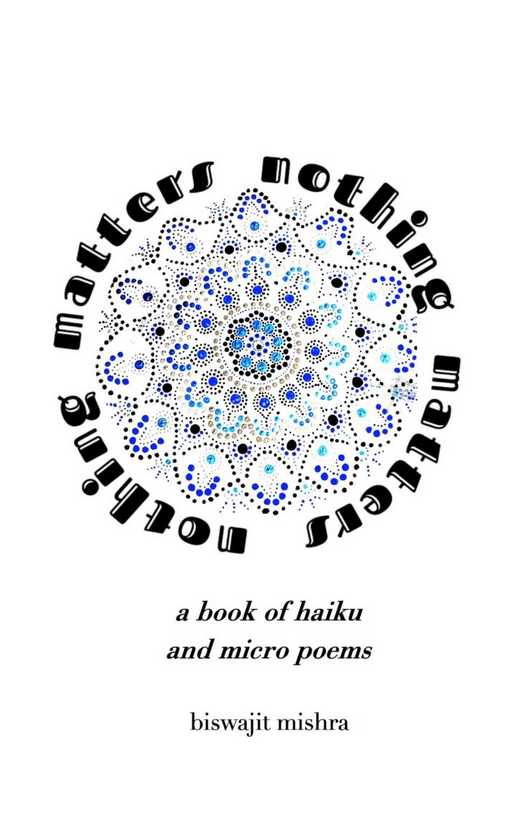
Book Review : Nothing Matters by Biswajit Mishra

Nothing Matters

a book of haiku

and micro poems

Book Details

Written by: Biswajit Mishra

Press: NUN PROPHET PRESS

ISBN: 9798258482242

Cover art by: Dr. Sukanya Neupane

Reviewed by: Bhawana Rathore

Nothing Matters is a collection of profound, introspective yet witty haiku and micro poems.

Through its experimental, philosophical approach and slice-of-life haiku, the book opens the door to layers of the mind where you find yourself observing thoughts as they arise and pass with each page turn, with each poem.

Throughout it’s entirety, Biswajit uses striking, vivid imagery and subtle play of words to paint the human experiences with such nuance that as a reader you find yourself in alignment with your own emotions.

Continue reading

An Attempt at Understanding Life: Between Doubt and Direction

I think, at some point in life, every person must have felt, “Why I am even doing this, for who, for what, at what cost, what is the meaning of all this, am I even on the right path, is this even meant for me, am I even capable ? ” etc, etc.

And these are some genuine questions, something that can not be brushed off by saying it’s just mind-talking.

As our entire existence is based on these thoughts, it’s the core of our thinking that guides us in a direction, towards taking action.

Continue reading

I did a 30 days poetry writing challenge

The first half of 2023 was just plain empty in terms of writing. Because of work, I couldn’t write and also, there was a major writer’s block (yeah, that happens) 🙂

So after getting a chance to travel in May and June, I found my creativity back and started writing again. Although, didn’t publish many haiku/senryu. Well, I mostly write haiku poetry and in awe of this art. I wrote lot of poems and enjoyed the journey.

Continue reading

© 2026 as words fly

Theme by Anders Noren — Up ↑