Category: Book Nook

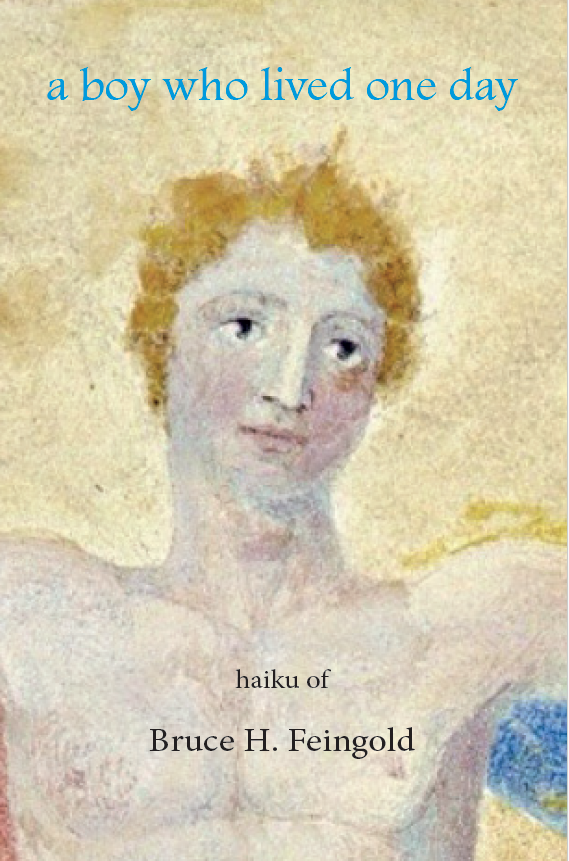
Book Review : a boy who lived one day by Bruce H. Feingold
Reviewed by Bhawana Rathore


Featuring William Blake’s Glad Day, or The Dance of Albion (1795) as its cover art, Bruce H. Feingold’s a boy who lived one day, dedicated to his grandchildren, opens with a beautiful prologue—

fork in the trail
I’ve never walked
either way

Reminiscent of Robert Frost’s famous poem The Road Not Taken, it offers a glimpse into the world that unfolds across the collection.

Each individual experiences life differently, and sometimes, none of the crossroads seem to make sense. But with each phase of life, the journey takes its own shape, as does this wonderful book.
Divided into prologue, interlogue, and epilogue, this is a collection of haiku and senryu that were published over the years in various magazines and journals, several of which have received awards.
Immersive, rich in imagery, and profundity, a boy who lived one day is a beautiful record of life, through its many cherished moments, exploring and embracing the nuances of existence, identity, grief, joy, and his life after retirement.


It showcases the poet’s penmanship through layered, sharp, and well-crafted haiku and senryu that capture the beauty, and fragility of life as well as a ravishing depiction and observation of nature, and the wildlife. Through the use of vivid imagery, brevity and juxtaposition, a distinct sense of reverence can be
observed in his writing.

skimming the lake mist a night heron’s croak

weathered driftwood
the beach where we decided
to get married

With its picturesque imagery, this poem so beautifully reminisces about beginnings, the promise of building a life together, and the beauty of growing, striving, and finding one’s way alongside another.

Having worked as a psychologist for fifty years, Feingold effortlessly captures subtle yet profound emotions. Without ever stating the obvious, his liminal approach ventures into the subconscious, unravelling the threads of elusive introspection.

the snap
of a grouse’s neck
my boyhood self


Pygmy forest
sometimes I too
am root-bound

There is an ineffable tenderness in his expression as he reminisces about his childhood and his father. With an undercurrent of nostalgia, joy and a subtle portrayal of grief, these poems become bridge between different phases of life, holding within the passage of time, intricacies of familial bonds, and the
fleeting moments.

holding dad’s hand
at my first game
stadium lights

His poems also capture the precious bond he shares with his grandchildren. Looking at life through a child’s gaze, with their innocence and wonder, and discovering the extraordinary in the ordinary, there is something almost magical about this return to childhood.

35 times older . . .
watching a dump truck
with my grandson

As a psychologist and a poet, he writes poems that are deeply resonant and empathetic, delicately unravelling the realization, and gratitude for life. And with each page turn, the book progresses into a deeper state of human mind with an acceptance towards the inevitable.

departing autumn
a few more years left
on my heart battery

the rise and fall
of dad’s voice
Sabbath blessings

a boy who lived one day is not only an exemplary work of fine poetry but also embodies the very essence of living and feeling. With his Jewish heritage, his practice as a psychologist, his travels, and life experiences, the touch of simplicity in the Feingold’s writing is utterly captivating.


Atmospheric, scenic, and empathetic, this collection traverses time, true to its title, following the poet’s journey from being a child to becoming a grandfather. This book grips the reader with its beautiful balance of life and living. At instances, one cannot help but relate to it and feel how some experiences
remain universal, and how effortlessly he manages to convey them.

eight decades…
still dreaming I missed
an assignment

To realize that the nightmares of missed assignments and unfinished exams never quite leave us, that they can catch us off guard at any phase of life, is strangely comforting. There is a subtle humor in it, an irony that even after a lifetime of growing, becoming other versions of ourselves, some part of us remains forever a student, still haunted by deadlines and the fear of having forgotten something important.

It’s this particular charm of his writing, the way he brings out familiar yet unexpected emotions, that makes the collection such a profound and delightful read.

A few personal favorites —

breaking waves
we talk with our children
about our ashes

green comet I commune with the Neanderthals

spring morning
my granddaughter and I shake out
poppy seed pods

I found the bond he shares with his grandchildren particularly endearing, one of the most precious highlights of the collection for me.
Truly a beautiful read, yet another exquisite addition to the haiku world.

life goes on
my heart settles back
into rhythm

Bruce H. Feingold, a boy who lived one day, Red Moon Press, 2026

The cost of a copy is $22 for the U.S.A or $30 for an international. To purchase a copy you can email him at drbrucefeingold@gmail.com or contact Red Moon Press.


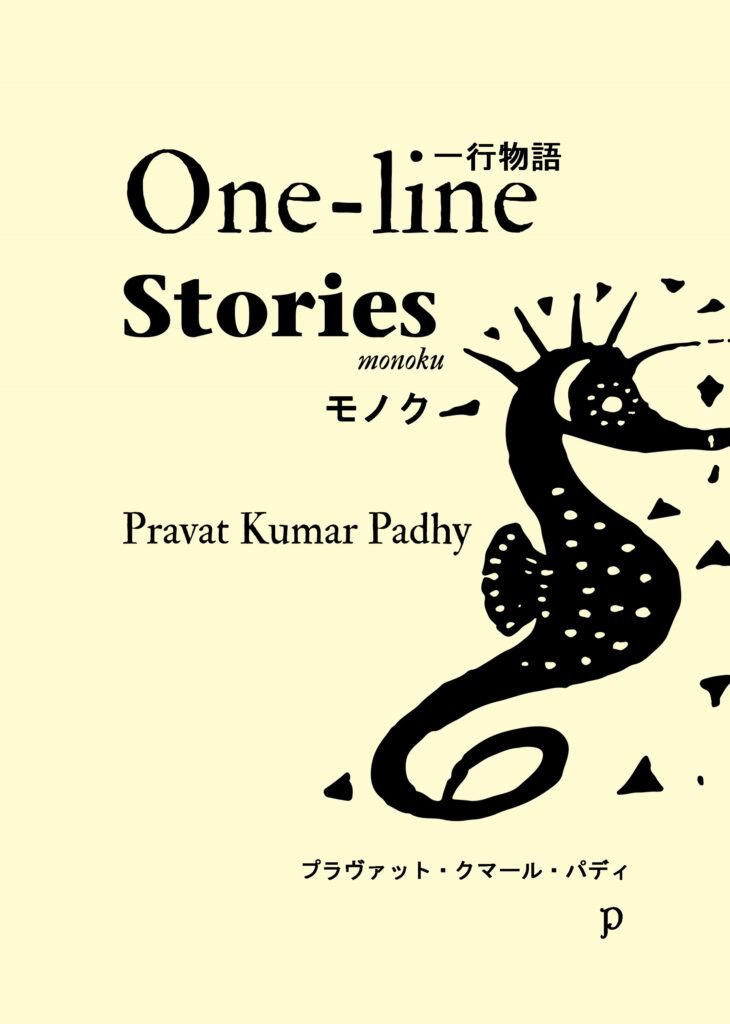
Book Review : Weaving Magic by Dr. Pravat Kumar Padhy


Johannes S. H. Bjerg says about one-line haiku:
“One-line haiku seems to be a discipline of its own. What I have discovered is that it represents another way of thinking, perceiving (sensing), of “speaking” than a three-line haiku and often with more energy in it as it’s even more condensed in thought and sensing than a three-line verse.”
Monoku or one-line haiku in English can be a challenge even to experienced writers, with the jux and the enjambment, the curve-back and the super brevity that make it as exciting as precise, in landing the desired effect. It is with this in mind that I read Dr. Padhy’s latest offering, a collection of monoku, which I found to be high in energy, spontaneous and the starting point of many stories.


a stone in her tiny hand once a mountain


The poem takes us on a long journey back in time to the origins of a stone. The poet contrasts the stone in a tiny hand in the present moment with the giant mountain of the past, and leads the reader deftly to a future of giant possibilities.
Alan Summers, in the Foreword to One-line Stories tells us of his search for single-line ku could be an effective start or finish of a short story or novel. Dr. Padhy’s one-liner poems can definitely do that. For instance, this one:


the train I board flags the green light of memories


Wouldn’t this make a good beginning of a novel? Or maybe, this works even better if the protagonist has finished his story and is boarding a train. Doesn’t it all depend on the imagination of the reader?
Dr. Padhy has never been one to let the reader shirk his/her responsibility. His haiku and tanka require that the reader engage with the poem and do the work of completing the image, moment or story in their own minds. In the case of the monoku in this book too, he makes the reader an important part of the poem, without really handing everything in a platter. (This is perhaps, a trait that he acquired from his researcher-scientist-teacher profession and has most effectively used in his haiku writing as well.)


who I am the body contours who I am not


In Japanese haiku, the poets have a choice of which of the scripts they use to depict their haiku. Will they use hiragana, katakana or kanji? And a haiku can have a mixture of all three scripts. The choice depends on what impression or feeling a poet wants to convey through the haiku. Does one want a more formal tone or is it a softer emotion? Are there homophones that need to be distinguished? Is there a light humour intended? All of this (and more) decides the choice. Similarly, does one want to write it in one line or three? That too is less of a genre difference and more of personal choice, unlike in English Language Haiku where the rules of engagement change with the number of lines.


dreams she conceals winter chrysanthemum


This haiku is an example of a one-breath (or even a rushed breath) poem. It is in the re-reading or the engagement with the words after we have slowed down, that the meanings and layers emerge, the possibilities within our own fertile imaginations lending to it growth, separate from what the poet intended. I for one, was struck by the image of the multiple and complex layers in the chrysanthemum. For some strange reason, pairing it with winter gave me an image of white blooms (winter=white). Another reading, and the various colours emerged but only after I nudged my brain to the colourful blooms at the neighbourhood florist! And then the layers unfold as the reader decides where to pause in the ku – after ‘dreams’ or ‘conceals’. Each possibility reveals a different layer and adds to the permutations for the reader. To visualise the colour, the season, the transitions, all leave the reader richer. And I would have missed all of this by giving it just a cursory read.

so close to the moon every kiss a nearby star


Dr. Padhy writes with ease and with the intent of an engaging storyteller. This haiku made me stop at each moment and think of the potentiality, for that’s what stories must do. Make us think of a different ending, an ability to change hopelessness into golden sunrises and unpolluted rivers. The poet provides us that spark and we must create the magic together with him.
The poet states in his preface to the One-line Stories: “Poems come to my mind as fragrance to flower. Anything I see, it creates a symbolic frame ……… when I see a small grain of seed, I feel “it is tiny / because it nests with care / the mightiest in it.”


a piece of chalk in my pocket first day of retirement


Perhaps, the first day of retirement made for a joyous commitment to a deeper and longer journey on the haikai path for Dr Padhy.
For those of us who love one-line haiku, this book is a delight. Please read this for Dr. Padhy’s poems and for Alan Summers’ insightful foreword on one-line haiku.


(One-line Stories by Dr. Pravat Kumar Padhy is available on Amazon.)

Note: For more in-depth information on monoku, the poet’s article “Monoku: Historical Perspective and Experimenting with Structural Style,” published in The Wales Haiku Journal Blog, September 2022 is an informative article that can be read here: https://www.waleshaikujournal.com/post/monoku.

Link for the book at Penprints- One-line stories by Dr. Pravat Kumar Padhy


Fall book recs

You’ve got We Fell in Love in October by girl in red and Season of the Witch by Lana Del Rey playing on repeat. You’re counting down the days until you can get your hands on Starbucks’ pumpkin spice flavours, and you’re seriously considering a re-watch of Harry Potter and the Prisoner of Azkaban — because honestly, autumn just wouldn’t feel like autumn without a little Hogwarts magic.
And even if the leaves aren’t changing colour where you live, the evenings are getting colder, and all you want is a warm drink, a cosy blanket, and a book that makes the rest of the world disappear, you’ve come to the right place.
Here are the fall book recommendations that’ll make you want to romanticise every little moment of the season.

Continue reading

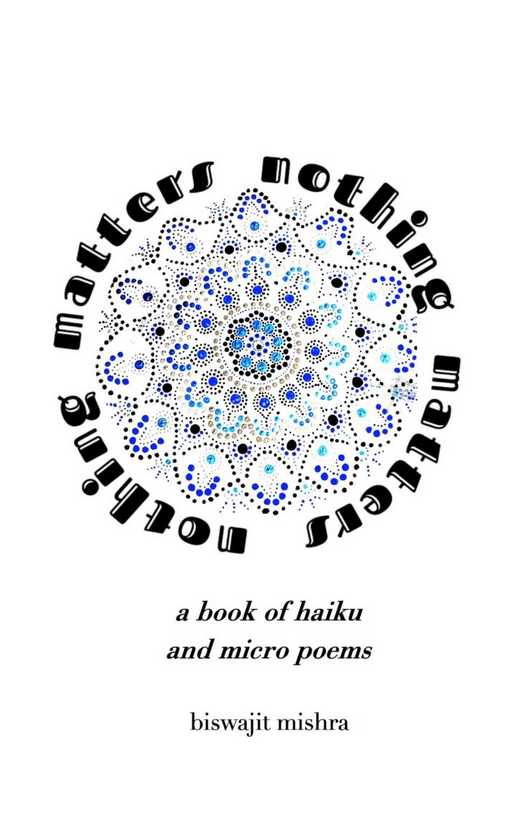
Book Review : Nothing Matters by Biswajit Mishra

Nothing Matters

a book of haiku

and micro poems

Book Details

Written by: Biswajit Mishra

Press: NUN PROPHET PRESS

ISBN: 9798258482242

Cover art by: Dr. Sukanya Neupane

Reviewed by: Bhawana Rathore

Nothing Matters is a collection of profound, introspective yet witty haiku and micro poems.

Through its experimental, philosophical approach and slice-of-life haiku, the book opens the door to layers of the mind where you find yourself observing thoughts as they arise and pass with each page turn, with each poem.

Throughout it’s entirety, Biswajit uses striking, vivid imagery and subtle play of words to paint the human experiences with such nuance that as a reader you find yourself in alignment with your own emotions.

Continue reading

© 2026 as words fly

Theme by Anders Noren — Up ↑