Category: issue 3 (Page 1 of 3)

Book Review : a boy who lived one day by Bruce H. Feingold
Reviewed by Bhawana Rathore


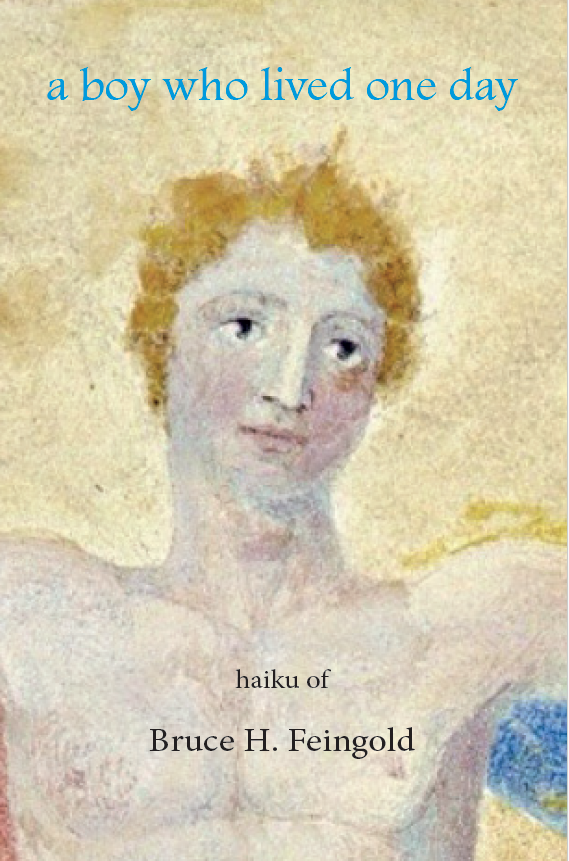
Featuring William Blake’s Glad Day, or The Dance of Albion (1795) as its cover art, Bruce H. Feingold’s a boy who lived one day, dedicated to his grandchildren, opens with a beautiful prologue—

fork in the trail
I’ve never walked
either way

Reminiscent of Robert Frost’s famous poem The Road Not Taken, it offers a glimpse into the world that unfolds across the collection.

Each individual experiences life differently, and sometimes, none of the crossroads seem to make sense. But with each phase of life, the journey takes its own shape, as does this wonderful book.
Divided into prologue, interlogue, and epilogue, this is a collection of haiku and senryu that were published over the years in various magazines and journals, several of which have received awards.
Immersive, rich in imagery, and profundity, a boy who lived one day is a beautiful record of life, through its many cherished moments, exploring and embracing the nuances of existence, identity, grief, joy, and his life after retirement.


It showcases the poet’s penmanship through layered, sharp, and well-crafted haiku and senryu that capture the beauty, and fragility of life as well as a ravishing depiction and observation of nature, and the wildlife. Through the use of vivid imagery, brevity and juxtaposition, a distinct sense of reverence can be
observed in his writing.

skimming the lake mist a night heron’s croak

weathered driftwood
the beach where we decided
to get married

With its picturesque imagery, this poem so beautifully reminisces about beginnings, the promise of building a life together, and the beauty of growing, striving, and finding one’s way alongside another.

Having worked as a psychologist for fifty years, Feingold effortlessly captures subtle yet profound emotions. Without ever stating the obvious, his liminal approach ventures into the subconscious, unravelling the threads of elusive introspection.

the snap
of a grouse’s neck
my boyhood self


Pygmy forest
sometimes I too
am root-bound

There is an ineffable tenderness in his expression as he reminisces about his childhood and his father. With an undercurrent of nostalgia, joy and a subtle portrayal of grief, these poems become bridge between different phases of life, holding within the passage of time, intricacies of familial bonds, and the
fleeting moments.

holding dad’s hand
at my first game
stadium lights

His poems also capture the precious bond he shares with his grandchildren. Looking at life through a child’s gaze, with their innocence and wonder, and discovering the extraordinary in the ordinary, there is something almost magical about this return to childhood.

35 times older . . .
watching a dump truck
with my grandson

As a psychologist and a poet, he writes poems that are deeply resonant and empathetic, delicately unravelling the realization, and gratitude for life. And with each page turn, the book progresses into a deeper state of human mind with an acceptance towards the inevitable.

departing autumn
a few more years left
on my heart battery

the rise and fall
of dad’s voice
Sabbath blessings

a boy who lived one day is not only an exemplary work of fine poetry but also embodies the very essence of living and feeling. With his Jewish heritage, his practice as a psychologist, his travels, and life experiences, the touch of simplicity in the Feingold’s writing is utterly captivating.


Atmospheric, scenic, and empathetic, this collection traverses time, true to its title, following the poet’s journey from being a child to becoming a grandfather. This book grips the reader with its beautiful balance of life and living. At instances, one cannot help but relate to it and feel how some experiences
remain universal, and how effortlessly he manages to convey them.

eight decades…
still dreaming I missed
an assignment

To realize that the nightmares of missed assignments and unfinished exams never quite leave us, that they can catch us off guard at any phase of life, is strangely comforting. There is a subtle humor in it, an irony that even after a lifetime of growing, becoming other versions of ourselves, some part of us remains forever a student, still haunted by deadlines and the fear of having forgotten something important.

It’s this particular charm of his writing, the way he brings out familiar yet unexpected emotions, that makes the collection such a profound and delightful read.

A few personal favorites —

breaking waves
we talk with our children
about our ashes

green comet I commune with the Neanderthals

spring morning
my granddaughter and I shake out
poppy seed pods

I found the bond he shares with his grandchildren particularly endearing, one of the most precious highlights of the collection for me.
Truly a beautiful read, yet another exquisite addition to the haiku world.

life goes on
my heart settles back
into rhythm

Bruce H. Feingold, a boy who lived one day, Red Moon Press, 2026

The cost of a copy is $22 for the U.S.A or $30 for an international. To purchase a copy you can email him at drbrucefeingold@gmail.com or contact Red Moon Press.


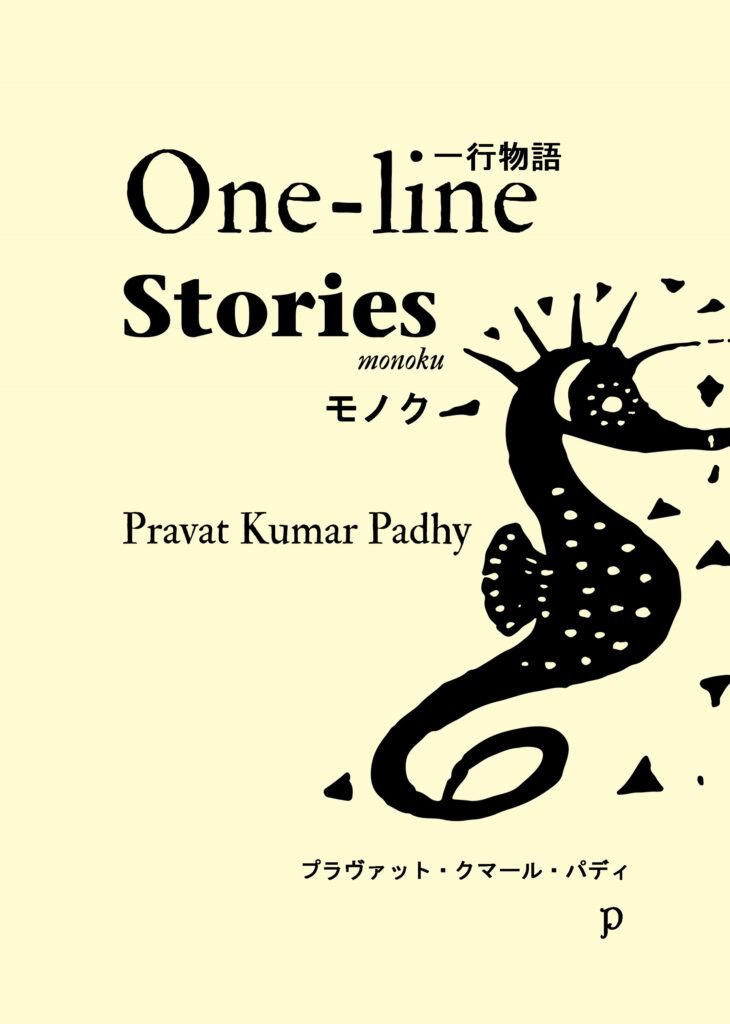
Book Review : Weaving Magic by Dr. Pravat Kumar Padhy


Johannes S. H. Bjerg says about one-line haiku:
“One-line haiku seems to be a discipline of its own. What I have discovered is that it represents another way of thinking, perceiving (sensing), of “speaking” than a three-line haiku and often with more energy in it as it’s even more condensed in thought and sensing than a three-line verse.”
Monoku or one-line haiku in English can be a challenge even to experienced writers, with the jux and the enjambment, the curve-back and the super brevity that make it as exciting as precise, in landing the desired effect. It is with this in mind that I read Dr. Padhy’s latest offering, a collection of monoku, which I found to be high in energy, spontaneous and the starting point of many stories.


a stone in her tiny hand once a mountain


The poem takes us on a long journey back in time to the origins of a stone. The poet contrasts the stone in a tiny hand in the present moment with the giant mountain of the past, and leads the reader deftly to a future of giant possibilities.
Alan Summers, in the Foreword to One-line Stories tells us of his search for single-line ku could be an effective start or finish of a short story or novel. Dr. Padhy’s one-liner poems can definitely do that. For instance, this one:


the train I board flags the green light of memories


Wouldn’t this make a good beginning of a novel? Or maybe, this works even better if the protagonist has finished his story and is boarding a train. Doesn’t it all depend on the imagination of the reader?
Dr. Padhy has never been one to let the reader shirk his/her responsibility. His haiku and tanka require that the reader engage with the poem and do the work of completing the image, moment or story in their own minds. In the case of the monoku in this book too, he makes the reader an important part of the poem, without really handing everything in a platter. (This is perhaps, a trait that he acquired from his researcher-scientist-teacher profession and has most effectively used in his haiku writing as well.)


who I am the body contours who I am not


In Japanese haiku, the poets have a choice of which of the scripts they use to depict their haiku. Will they use hiragana, katakana or kanji? And a haiku can have a mixture of all three scripts. The choice depends on what impression or feeling a poet wants to convey through the haiku. Does one want a more formal tone or is it a softer emotion? Are there homophones that need to be distinguished? Is there a light humour intended? All of this (and more) decides the choice. Similarly, does one want to write it in one line or three? That too is less of a genre difference and more of personal choice, unlike in English Language Haiku where the rules of engagement change with the number of lines.


dreams she conceals winter chrysanthemum


This haiku is an example of a one-breath (or even a rushed breath) poem. It is in the re-reading or the engagement with the words after we have slowed down, that the meanings and layers emerge, the possibilities within our own fertile imaginations lending to it growth, separate from what the poet intended. I for one, was struck by the image of the multiple and complex layers in the chrysanthemum. For some strange reason, pairing it with winter gave me an image of white blooms (winter=white). Another reading, and the various colours emerged but only after I nudged my brain to the colourful blooms at the neighbourhood florist! And then the layers unfold as the reader decides where to pause in the ku – after ‘dreams’ or ‘conceals’. Each possibility reveals a different layer and adds to the permutations for the reader. To visualise the colour, the season, the transitions, all leave the reader richer. And I would have missed all of this by giving it just a cursory read.

so close to the moon every kiss a nearby star


Dr. Padhy writes with ease and with the intent of an engaging storyteller. This haiku made me stop at each moment and think of the potentiality, for that’s what stories must do. Make us think of a different ending, an ability to change hopelessness into golden sunrises and unpolluted rivers. The poet provides us that spark and we must create the magic together with him.
The poet states in his preface to the One-line Stories: “Poems come to my mind as fragrance to flower. Anything I see, it creates a symbolic frame ……… when I see a small grain of seed, I feel “it is tiny / because it nests with care / the mightiest in it.”


a piece of chalk in my pocket first day of retirement


Perhaps, the first day of retirement made for a joyous commitment to a deeper and longer journey on the haikai path for Dr Padhy.
For those of us who love one-line haiku, this book is a delight. Please read this for Dr. Padhy’s poems and for Alan Summers’ insightful foreword on one-line haiku.


(One-line Stories by Dr. Pravat Kumar Padhy is available on Amazon.)

Note: For more in-depth information on monoku, the poet’s article “Monoku: Historical Perspective and Experimenting with Structural Style,” published in The Wales Haiku Journal Blog, September 2022 is an informative article that can be read here: https://www.waleshaikujournal.com/post/monoku.

Link for the book at Penprints- One-line stories by Dr. Pravat Kumar Padhy


Exploring the Meta-Haiku

By Chen-ou Liu, Canada


Bridging traditional brevity with sharp self-awareness, the meta-haiku turns the poetic lens inward. Rather than capturing a fleeting moment in nature, this self-reflexive form makes the anxious act of composition—and the constraints of its own three-line structure—the subject of the poem.

For example:

before false dawn
just three lines, blinking cursor
after sun down

There is a clear syntactic parallelism between Lines 1 and 3 (before [noun phrase] / after [noun phrase]). This grammatical mirroring creates a structural frame, establishing a mechanical, almost clockwork rhythm that evokes the passage of time. Within this frame, the middle line—and the narrator—seems trapped in a temporal loop.

By balancing the beginning and the end, the haiku formally enacts the very stagnation it describes. The day comes full circle, returning to its point of departure and leaving the narrator suspended in creative limbo.

Line 2 introduces the poem’s central image: the blinking cursor. Its rhythm evokes the hypnotic, faintly irritating pulse of a blank digital canvas. Here, a striking contrast emerges between the sweeping, macro-level movements of natural light—from false dawn to sundown—and the micro-level, artificial pulse of the screen. While the world turns through its daily cycle, the speaker remains fixed before a few inches of pixels.

The phrase “false dawn” carries a double significance. Literally, it refers to a deceptive glimmer of light before sunrise; metaphorically, it suggests the false starts and fleeting promises of creative inspiration. From the outset, then, the poem establishes an atmosphere of anticipated progress that never quite materializes.

Yet the poem’s ultimate payoff lies in its layers of meta-literary irony. It depicts a state of apparent artistic paralysis: after what seems to be a day-long vigil, the narrator has produced “just three lines” and remains transfixed by a blinking cursor.

The irony, of course, is that a haiku traditionally consists of three lines. The very statement of failure is itself a completed work. The narrator has crafted a concise, carefully structured poem to articulate the inability to write one. What appears to be creative stagnation is, in fact, a quiet act of creation.

By allowing its form to enact this paradox, the meta-haiku offers a subtle yet incisive critique of the creative process in the digital age. The screen’s blinking cursor becomes both an emblem of paralysis and a metronome for the poem’s restrained rhythm. The result is a finished monument to the feeling of being perpetually unfinished.


Lux in Tenebris

By Sreelekha Chatterjee


It’s that time of the year when sunlight—once plentiful and abundant—mellows down. The sun takes a brisk, dispassionate course through the sky, like a much-awaited guest who arrives and almost immediately departs. My mind—disarranged by events, places, people, and sapped by the customs of quotidian existence—suddenly asks for a harvest to winnow the wheat from the chaff, resolving disorder into a pattern, ordo ab chao. Even Nature gracefully foreswears the claim to all its time-bound verdant and fruitful escapades—dropping the whispered truth of impermanence and the imperishability of change.

Liquidation of the previous seasons has a kind of charm to it. The daily walks, which kept deferring like the langour of a festival long held up, begin. Amid the solitude of a busy road, a wordless presence grips the air, as subtle and pervasive as the rich and heavy smokeless aroma of clarified butter in a fire oblation. With the street-side symphony echoing the pulsing heartbeats of festive drums, the celebration of inner Navratri supervenes—nine stages of overcoming the lower self. I learn a bit about my veiled identity.

Memories appear like the varicoloured, migratory birds that bring jollity of colour and brightness to the grey routine of my everyday life. My tiny fingers twirled around that of my grandmother’s, as we walk towards the milk booth, about 5–10 minutes away from our house. It’s more like an ant’s crawl, meeting and socialising with every single person on the road, the treat of being known and remaining connected. My mother’s hand is firm and perspicacious, as she introduces me to the concept of pedestrianism. The roads now are more crowded, with pavements mostly dissolved to accommodate extra vehicles, perhaps beyond necessity, like the complexities of a grown-up life. Uninfluenced by the vagaries of mind and emotion, the urge to unwind—to relax in the middle of the perpetual commuter chaos—is like a treasured souvenir. Swarmed with inspirations from people whom we see but never meet, the fragrances of their lives embellishing and filling the void that is so true of the liberating season.

All that melts and grows into the distance, into higher forms of understanding, is routed back into the mortal consciousness. The freshness of oranges, the feel of peaches and the delectability of nuts—no longer ethereal fruits dreamt of in summer—physically weave in their bouquet, the dreams of a tomorrow, yet to be decided. Yearning for sustainability prevails, so does longings without set boundaries. While negotiations keep happening with life, the longer jackets of fulfillment are worn to keep warm, channeling back to our cosy shelter. Lambent coherence of the knowledgeable self with the subconscious stands tall like the thread of light emanating from an earthen lamp that illuminates—when in multitude—the mystic night of the dark moon.


first snow
the quiet weight
of unsent letters

Manasa Reddy Chichili, India

candle ice lake
the clink of their
break-up

Bipasha Majumder (De), India

bush fires
everything I wanted to say
up in smoke

Baisali Chatterjee Dutt, USA / India

divorce papers
I finish the last
of the dried persimmon

Morgan Ophir, Australia

alone, on a mountain lake,
Venus flings its light
fish-splash…
I cannot remember
the last time I saw you

Tani D Arness, United States

3 a.m.
the warmth of my breath
in a city chapel

Hynek Koziol, Czechia

winter morning
the weathered rug
dappled with sun

Geethanjali Rajan, India

winter breeze
blowing softly on the porch
cinnamon tea
grandma takes her time
talking between sips

Minal Sarosh, India

hummingbird
the garden swaying
on its feet,
I try to catch what I can
of my erratic breath

Minal Sarosh, India

fearless
you swim out
into open sea
coalescing, my passion
becomes a pearl

Farah Ali, UK

frost on the window
his name still warm
in my mouth

Manasa Reddy Chichili, India

lovers’ quarrel
we still hold hands
in the snow

Jahnavi Gogoi, Canada

chill night
a war siren adds
to the newborn’s cry

Bipasha Majumder (De), India

a refugee’s stare
the sound of winter wind
caught in barbed wire

Chen-ou Liu, Canada

barred window
each square
with its shade of blue

Hynek Koziol, Czechia

holding still
an old grief…
late night drizzle

Hifsa Ashraf, Pakistan

from a distance
a deer’s wilting call,
almost an echo …
       a moaning so deep
I’m restless through the night

Kala Ramesh, India

last night
winter sculpted art
in hoarfrost
last night fear of losing you
bloomed inside me like a bruise

Farah Ali, UK

she sighs again
those kicks, flutters, rolls
…then nothing
I turn to gaze out the window
beneath a bare winter sky

Chen-ou Liu, Canada

silver grass path
      chilly breeze
from the cyclist

Keiko Izawa, Japan

first frost—
the postman
still in shorts

Thomas David,United Kingdom

thrift shop
the cat curled in the window
not for sale

Louise Hopewell, Australia

silently stepping
on winter moonshine
the old white cat

Geethanjali Rajan, India

wrapping around
the warmth of pashmina
winter stars

Rupa Anand, India

moth wings. . .
loose thread
of dad’s sweater

Neha Singh Soni, India

river bend—
a ripple of winter light
in dad’s hair

Adele Evershed, USA

patches of fog …
alone by the window
of his care home
Father fades once again
into his trench days

Chen-ou Liu, Canada

laptop dinner
my husband
sells another cloud

Morgan Ophir, Australia

back to       I am       white balance

Biswajit Mishra, Canada

cosmic intelligence—
even as AI learns
without pause
the moon lifts
another tide

Sathya Venkatesh, India

testing
her hearing aids
wren song

Neha Singh Soni, India

just about autumn…
making a list
for the doctor

Biswajit Mishra, Canada

the doctor’s
ifs and buts
autumn snow

Alvin B. Cruz, Philippines

drops of honey
on the bookmark—
Parkinson

Mircea Moldovan, România

truck driver
drifting through the fog
a Rafi song

Govind Paliath, India

eastern fog
I slide up
the valley’s gradient

Tré, USA

early dusk—
on the frozen runway
gull tracks

Souvik Chakraborty, India

snow drops
on the Sherpa’s beard
base camp

Rupa Anand, India

sea fog
dingo tracks vanish
from the sand

Lorraine haig, Australia

dense fog
swallows the shorelines
a ferry’s foghorn
sounds like a beloved
wailing for her mate

Kala Ramesh, India

lanternless I roam
the misty moors of longing
night after night
uprooting pricking thistles
from my heart and memory

Farah Ali, UK

harvest moon
the path keeps winding
beyond the fields
I carry less and less
of all I thought I needed

Neena Singh, India

« Older posts

© 2026 as words fly

Theme by Anders Noren — Up ↑