Author: aswordsfly.com (Page 2 of 5)

school holidays
in the empty yard
flame tree blossoms

—Tuyet Van Do, Australia

komorebi
the chameleon
half hidden

—Leon Tefft, USA

shrinking lake
the throaty rasping
of a raven

—Louise Hopewell, Australia

peach iced tea
a wasp determined
to have its fill

—Deborah Karl-Brandt, Germany

summer heat i become the mirage

—Mona Bedi, India

heat wave
looking for shade
a white cane

—Mircea Moldovan, România

communing over the fence summer squashes

—Julie Schwerin, United States

mirror pond
a water strider skates
through the sun

Deborah Karl-Brandt, Germany


heatwave
a mannequin posing
in her bathing suit

—Keiko Izawa,Japan

mercury rising
an atlas moth lands
on my paper fan

—Jahnavi Gogoi, Canada

dog days
the perennial river
crawls to a halt

—Geethanjali Rajan, India

heatwave —
call of landing gulls
ride the breeze

—Sheikha A., United Arab Emirates

summer heat
my grandsons and I build
a sandcastle

—Nancy Brady, US

taste of salt—
the light melodies
of summer waves

—Paul Callus, Malta

heatwave
a lobster waits
the incoming tide

—Steliana Cristina Voicu, Romania

a sign warns
of drowning risk
dry lakebed

—Louise Hopewell, Australia


By Haripriya

Yet my heart is sweet
with the memory of the first fresh jasmines
that filled my hands
when I was a child.

Rabindranath Tagore

carpet of parijat –
orange stems
of a childhood sky

—Vishal Prabhu, India

jasmine hedge
the sweet fragrance
of magpie song

—Louise Hopewell, Australia

jasmine breeze
a door left open
to the night

—Leon Tefft, USA

open window —
a night jasmine trails in
with the moon

—Rupa Anand, India

gentle rain
a snake silvers
the jasmine vine

Geethanjali Rajan, India

summer breeze
lingering scent of jasmine
from mother’s braid

—Mona Bedi, India

flower market
i haggle over a wilted
jasmine gajra

—Jahnavi Gogoi, Canada

mother’s hands
oiling my long hair…
scent of jasmine

—Neena Singh, India

Come, the young violets crowd my door,
Thy earliest look to win,
And at my silent window-sill
The jessamine peeps in.

William Cullen Bryant


Editor’s Note – Issue 2

By Haripriya

bassinet
basking in basil . . .
balmy breeze

—Monica Kakkar, India and USA

laundry day
slow-moving piles
of clouds

—Julie Schwerin, United States

improvising cuff links summer fluke

—Jerome Berglund, USA

lakeside camping
we skim stone after stone
into the stars

—Chen-ou Liu, Canada

blooming an ocean apart African violet

—Biswajit Mishra, Canada

sowing rice
a mother sings to the child
on her back

—Jahnavi Gogoi, Canada

sunlit rain
unceasing trill
from a far off hedge

—Tim Dwyer, Northern Ireland/USA


Touchstone Nominations 2026

Our first Touchstone Award Nominations from the – Issue 01, Spring 2026

evening prayer fades
the dust of marigold
in my palms

— Dr. Anish Kumar Gupta, India

faded marigold —
the bride’s father lingers
at the doorway 

— Vaishnavi Ramaswamy, India

second day of snowfall…
the warmth of your
(c)love mulled wine

— Steliana Cristina Voicu, Romania

balmy spring day 
a toddler in the yellow hat 
almost stands

— Keiko Izawa, Japan

summer stars
a pushcart vendor sells
his last mango 

— Neha Singh Soni, India

lone beach stroll
wave after wave 
of old grief

— Chen-ou Liu, Canada

creeping jenny
recalling names
more slowly now

— Leon Tefft,USA

angel’s wing mushroom
not a flutter
on the ultrasound

— Adele Evershed, USA

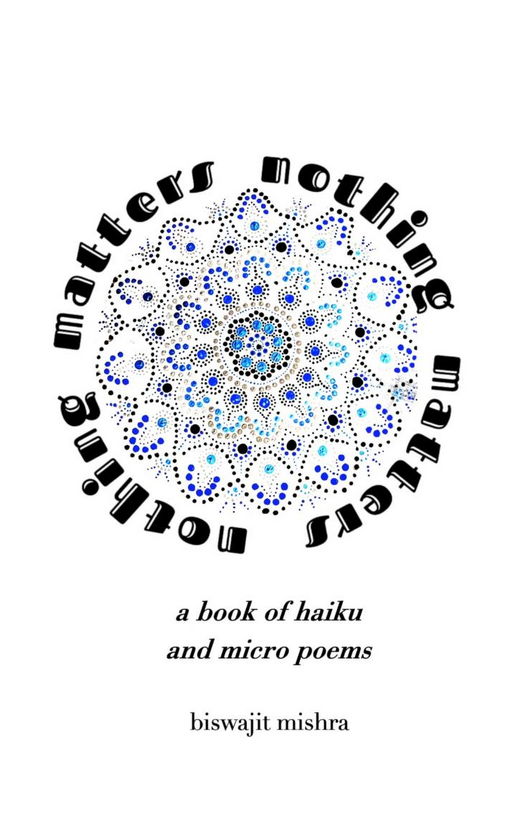
Book Review : Nothing Matters by Biswajit Mishra

Nothing Matters

a book of haiku

and micro poems

Book Details

Written by: Biswajit Mishra

Press: NUN PROPHET PRESS

ISBN: 9798258482242

Cover art by: Dr. Sukanya Neupane

Reviewed by: Bhawana Rathore

Nothing Matters is a collection of profound, introspective yet witty haiku and micro poems.

Through its experimental, philosophical approach and slice-of-life haiku, the book opens the door to layers of the mind where you find yourself observing thoughts as they arise and pass with each page turn, with each poem.

Throughout it’s entirety, Biswajit uses striking, vivid imagery and subtle play of words to paint the human experiences with such nuance that as a reader you find yourself in alignment with your own emotions.

Continue reading
By Sreelekha Chatterjee —India

A Darkness No Star Can Melt Births a New Dawn

Like that day, the storm was on. The only difference was that the storm was happening only outside. Sweeping in a demonic wave, it erased the memories’ vestige of calm, with a shadowy flounce over the dark jade deep. Gusty winds stirred up caravans of dust, cloaking all in a haze. Moats of dirt gathered around every object—both living and nonliving. Akin to a super fast train arrowing through, the heavy axe of the blast hewed tree branches and leaves fell, too.

A clamorous wind blew in, while silver lances tossed in the sky, and almost uprooted the black plum tree before our eyes. It leaned forward, lowering its towering height; stretching out its hands east and west, whining in vain for a peaceful rest; continued to bend its neck; and drooping its branches, almost pressed against the ground. We were like turtles upturned, their world upside down, unable to right themselves, or flip back onto their feet. There appeared an ecstatic crowd of humans, their voices in clanging flight. Their arms winged with victory over the salubrious tree that was delimbed, its only fault being encroachment on territories the humans called their own.

Similar to a struck frog, we convulsed but never cried in pain. Our faces grave white, our attire like white flower wreaths, feeling the teeth of soreness scraping our peace within, while we awaited an awakening the souls did retreat.

We don’t know when the storm inside perished, leaving us vacuous and impassive. A solemn slumber captivated us that forgot to vex, to burn in distress. Invisible manacles clanked on our immobile hands.

For long, the tree remained in a benumbed state—no chirping of birds, no visitation of bees, no hugging of squirrels could release the unease, loosen the tensed wire that remained suspended within.

The gale had let wild man-of-war birds and falcons free—flapping wide wings and gnawing on the unrelenting pain. Down in the treacherous abyss of our minds, death held its flag alive. A strong blow to our health, a threat to our continuance, was on. In our desolate houses were heard the enduring, pensive children’s tireless pleas to climb onto life’s lap, leaving unvoiced sobbing surfs of threnody.

The supersonic blow tried its utmost to deracinate the tree. It survived the wallop, twisting and curving in positions never seen, unfamiliar to believe. Perhaps the rule of life is to go on, irrespective of the frozen memories—which remain like a bone stuck in the esophagus, refusing to let go—that resolve never to thaw again.

On the following day, the tree seemed lighter than usual—displaced by the squall, slanted at about 60 degrees to the vertical. Its tensed branches were at ease, stirring gently in the summer zephyr. A few days later, the hardened discomfort lessened. From the limbless, white-embattled branches once bitten by foes, gorgeous, fiery new leaves sprouted from within to exhibit pageantry that fit the common, dreadless days ahead.

About
Sreelekha Chatterjee is an award-winning short story writer, poet, and editor from New Delhi, India. Her stories have appeared in Kitaab, Ink Pantry, Mad Swirl, The Piker Press, York Literary Review, Borderless, Literary Cocktail Magazine, Underbelly Press, and elsewhere.
Facebook: facebook.com/sreelekha.chatterjee.1 , X (formerly Twitter): @sreelekha001 , Instagram: @sreelekha2023 , Bluesky: @sreelekha2024
By Martina Matijević —Croatia

The Paintku Project

H aikuists have long been inspired by paintings, yet there is no formal framework for approaching this practice without confusing it with related poetic forms such as haiga or photo-haiku. To address this gap, the author started The Paintku Project on her Bluesky account, from which some of the Paintku serve as examples supporting newly established guidelines for this emerging genre.

As the name suggests, a Paintku is a noun combining painting with the suffix -ku, signaling the fusion of this visual art and haiku. However, defining it simply as “a haiku inspired by a painting” is too vague. A Paintku should be understood as a haiku inspired by a painting in its entirety, or by one or more of its motifs, compositional elements, or other constituent features. Through engagement with these elements, a Paintku seeks to capture the essence of the painting’s primary theme, one or more subthemes, a prevailing emotional atmosphere, or another distinct and meaningful aspect of the artwork.

For example, the first painting addressed in the project was Norman Rockwell’s Freedom of Speech (1943), which inspired the Paintku:

in neighbors’ gaze
the depth
of his speech

The fundamental rule for writing a successful Paintku is that it must not merely describe the painting. Instead, it should contribute new insight through careful engagement with the work. This insight may illuminate an emotional absence:

spring gust –
the absence of
mother’s cry

(A Paintku about Pablo Picasso’s Guernica, 1937.)

A Paintku must function as a standalone poem, distinct from the painting itself and clearly separable from haibun, photo-haiku, or ekphrastic description.

A second guiding principle is stylistic correspondence: the language and approach of a Paintku should, when possible, resonate with the aesthetic qualities of the painting. Minimalist works may invite spare, restrained language, while a Cubist painting may justify fragmentation or syntactic tension. For instance, Pierre-Auguste Renoir’s Dance at Le Moulin de la Galette (1876), with its fleeting, light-filled Impressionist style, inspired the Paintku:

the laughter
of dancing couples
twilight long

Here, the soft sounds and rhythm of the haiku echo the painting’s lively, ephemeral atmosphere.

Ultimately, The Paintku Project seeks to establish basic guidelines for this new poetic form, foster a community of poets interested in combining visual art with haiku, and create a unique dialogue around paintings. By engaging deeply with artworks in poetic form, participants can notice subtleties, themes, and emotional nuances that might otherwise be overlooked, enriching both their understanding of art and their own poetic practice.

About
Martina Matijević is a poet from Croatia whose short poetry has been published in Modern Haiku, Acorn, Autumn Moon Haiku Journal, and other journals.

Nalini

a lone flower
stands tall
much like my mother

all through her life
a determined bloom !

— Shikha Sawhney Lamba, Hong Kong

awake alone to the year’s first morning sun.

in the mirror
this familiar stranger …
a burst of birdsong

— Chen-ou Liu, Canada

THE DIGITAL AGE

No one makes
time to stare

at nothing
these days

we don’t make nothing.
Nothing does.

It is the time
that un-makes us all

— Mark Jackley, US

About

Shikha S. Lamba is a jewelry designer and poet living in Hong Kong. Her poems and photography have previously been nominated for Best of the Net and the Pushcart prize.

Chen-ou Liu is the author of five books, including “Following the Moon to the Maple Land” (First Prize, 2011 Haiku Pix Chapbook Contest) and “A Life in Transition and Translation” (Honorable Mention, 2014 Turtle Light Press Biennial Haiku Chapbook Competition). His tanka and haiku have been honored with many awards.

Mark Jackley’s poems have appeared in Frogpond, NOON, Password, and elsewhere. Read more of his poetry at www.markjackley.com

« Older posts Newer posts »

© 2026 as words fly

Theme by Anders NorenUp ↑